Stinging insect populations peak across Middle Tennessee from late June through October, driven by sustained humidity and elevated foraging demands. In residential zones such as Belmont-Hillsboro, Sylvan Park, and…
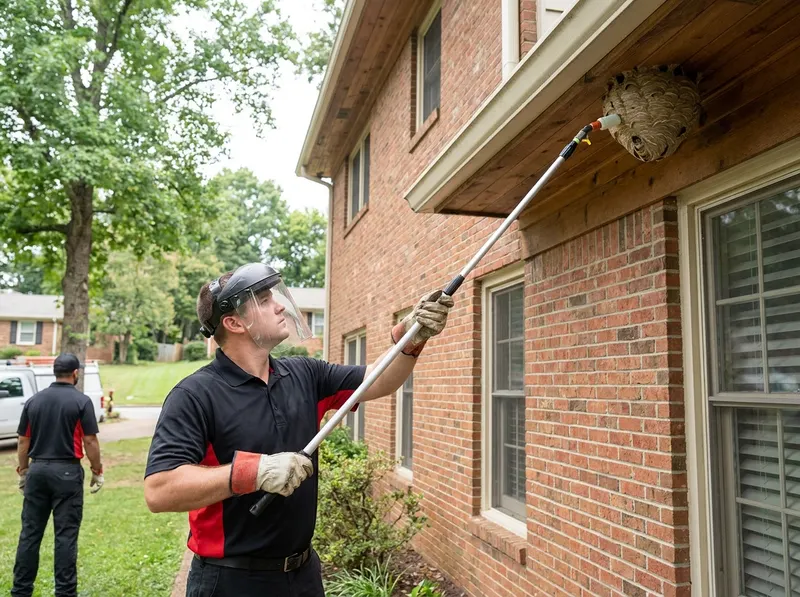
Stinging insect populations peak across Middle Tennessee from late June through October, driven by sustained humidity and elevated foraging demands. In residential zones such as Belmont-Hillsboro, Sylvan Park, and Green Hills, aerial paper wasps (*Polistes metricus*) frequently construct hexagonal brood combs beneath Victorian eaves, wooden soffits, and wrap-around porch decking. Conversely, bald-faced hornets (*Dolichovespula maculata*) form expansive, multi-tiered cellulose spheres inside mature tree canopies along the Cumberland River corridor and properties bordering Shelby Bottoms Greenway. The structural architecture of these colonies requires mechanical disruption matched with low-toxicity synthetic pyrethroid or dry-dust barriers certified under EPA pesticide safety standards. Subterranean species such as eastern yellowjackets (*Vespula maculifrons*) exploit rodent burrows in landscape beds near Centennial Park Parthenon and residential foundations in East Nashville and Inglewood. Attempting retail aerosol knockdowns often aggravates defensive stinging behavior, triggering widespread pheromone dispersion that prompts colony-wide defensiveness. Professional intervention isolates the primary flight gallery, injects micro-encapsulated formulations regulated by the Tennessee Department of Agriculture, and physically detaches the structural nest mass.
Selecting professional nest abatement rather than systemic property spraying minimizes environmental contamination and safeguards non-target beneficial pollinators. Standard broad-spectrum barrier sprays indiscriminately impact pollinators supported by resources at the Pollinator Partnership and local ecosystems surrounding Radnor Lake State Park and Cheekwood Estate & Gardens. CanyonWisp Pest Response prioritizes point-source applications directly into the nesting cavity. This precise methodology avoids ambient air drift into attic ventilation systems, domestic play areas, and HVAC return ducts, maintaining indoor environmental hygiene. Homeowners are not pressured into mandatory recurring multi-month contracts. Each nest is addressed as an isolated biological issue, balancing immediate domestic safety with ecological responsibility.
The standardized abatement protocol follows four sequential operations to ensure thorough structural sanitation. Step 1 begins with a daylight thermal and acoustic diagnostic review to map internal wall voiding or concealed roof soffits without puncturing drywall. Step 2 initiates micro-targeted directional misting or dry formulation application utilizing personal protective apparatus aligned with OSHA occupational protection protocols. Step 3 involves the physical mechanical detachment of the comb, followed by vacuum extraction of surviving structural foragers. Step 4 seals the exterior substrate junction points with copper mesh and silicone sealants to prevent reinfestation, complying with structural pest control standards supported by the National Pest Management Association. Property occupants in Germantown, The Nations, and Donelson can coordinate prompt field assistance by contacting (629) 319-7822.
Every job gets a firm, written price after an on-site visit.
Tell us about your stinging insect nest abatement job in Nashville and we'll send a clear, written quote, usually the same day.
 CanyonWisp Pest Response