CanyonWisp Pest ResponseCanyonWisp Pest Response

Residential Rodent Exclusion Nashville

Residential rodent exclusion provides structural containment rather than relying on perimeter broadcast bait stations that can pose unintended secondary exposure risks to family pets. In historical neighborhoods like…
Get My Estimate →(629) 319-7822
Residential Rodent Exclusion in Nashville, TN
Quick answer
  • What is included: Full perimeter architectural inspection, installation of 19-gauge galvanized steel mesh, exterior caulking, crawl space vent reinforcement, and interior trapping.
  • Turnaround time: Initial barrier assessments take 60 to 90 minutes, with exclusion repairs completed in one to two business days depending on property size.
  • Cost range: Perimeter sealing and interior trapping start at a $200 minimum assessment charge, ranging from $450 to $2,200 for complete structural exclusion.
  • Target species: Norway rats, roof rats, and house mice invading crawl spaces, basements, wall cavities, and attic insulation.
  • How to schedule: Call (629) 319-7822 to arrange a technician site evaluation, with precise scope and pricing confirmed on-site before any mechanical work begins.

Residential rodent exclusion provides structural containment rather than relying on perimeter broadcast bait stations that can pose unintended secondary exposure risks to family pets. In historical neighborhoods like East Nashville, Germantown, and Belmont-Hillsboro, older floor joists and limestone masonry foundations frequently develop settling gaps exceeding one-quarter inch, sufficient clearance for common field mice seeking thermal shelter. Rodents exploit subfloor access points near aging plumbing lines, ductwork, and siding transitions. Standard control methods depend on exterior toxicant blocks regulated by the EPA Rodenticide Safety Standards, but long-term resolution requires physical barrier defense governed by the CDC Rodent Prevention Protocols.

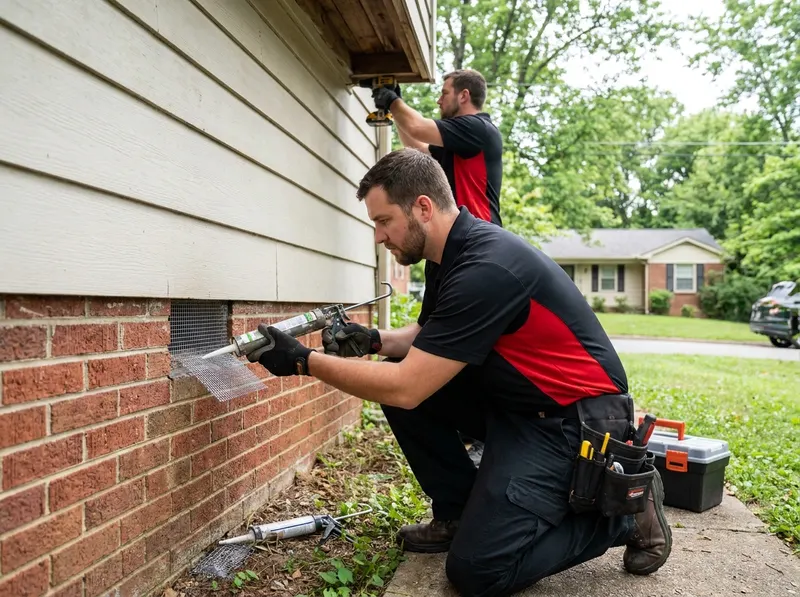
CanyonWisp Pest Response prioritizes low-impact mechanical defense over chemical dependency. Technicians inspect foundation vents, crawl space access hatches, ridge vents, and roof returns alongside mature tree canopies common in Green Hills and Sylvan Park, where roof rats travel overhead from overgrown river birch and oak limbs. The exclusion methodology follows specific building safety specifications endorsed by the InterNACHI Structural Pest Standards to ensure attic and crawl space airflow remains compliant with building codes. Technicians seal all exterior wall openings using rust-proof ASTM International certified galvanized hardware cloth, copper mesh, and elastomeric sealants that rodents cannot chew through.

For suburban properties in Donelson, Antioch, and The Nations, subterranean utility chases and garage weather stripping serve as primary entry routes. When foundation vents along crawl spaces degrade, field mice enter beneath subfloors, nesting directly inside R-19 fiberglass batt insulation. A comprehensive exclusion service repairs these penetrations rather than masking them with repetitive chemical treatments. Structural remediation follows safe residential guidelines supported by the HUD Office of Lead Hazard Control and Healthy Homes, minimizing airborne particulates and keeping nesting contamination away from living areas.

Technicians implement a defined five-stage mechanical process to clear and protect the structure:

  1. Step 1 involves an exhaustive 360-degree foundation, crawl space, attic, and roofline inspection to locate all entry points larger than one-quarter inch.
  2. Step 2 implements exterior structural exclusion by sealing voids with 19-gauge galvanized wire cloth, metal flashing, and structural sealants.
  3. Step 3 places mechanical, snap-style capture stations strictly within isolated, locked interior zones like attics and crawl spaces away from children and domestic pets.
  4. Step 4 monitors capture stations over a 7-to-14-day evaluation window to confirm zero interior activity remains within structural cavities.
  5. Step 5 concludes with sanitary reset, checking barrier integrity, and providing clean documentation of all sealed exterior structural access areas.

The primary trade-off between standard baiting programs and structural exclusion is initial effort versus long-term security. Bait services require indefinite recurring monthly fees and can cause rodents to expire in unretrievable wall voids. Architectural exclusion requires a higher upfront mechanical investment, but eliminates the structural ingress channels, maintaining clean internal air quality per ASHRAE Ventilation Standards. For homes near Shelby Bottoms Greenway in Inglewood or riparian corridors along the Cumberland River, rising moisture and seasonal shifts drive rodent surges each autumn, making permanent physical exclusion the reliable remedy.

How much does Residential Rodent Exclusion cost in Nashville?

Baseline Structural Assessment & Entry Inspection$200 - $350
Minor Mechanical Exclusion (1-3 targeted foundation/pipe gaps)$350 - $650
Standard Crawl Space & Foundation Exclusion (Up to 2,000 sq ft)$850 - $1,600
Complete Structural & Roofline Exclusion (Multi-story, 2,500+ sq ft)$1,500 - $2,800
Attic Sanitation & Localized Insulation Extraction$600 - $2,200

Every job gets a firm, written price after an on-site visit.

Common questions

What is the minimum cost for rodent exclusion service in Nashville?
The minimum charge for a diagnostic inspection and localized entry repair in Nashville is $200, with comprehensive property exclusion plans estimated on-site based on total linear feet and structural complexity.
How does weather along the Cumberland River in Nashville affect rodent activity?
Autumn temperature drops and seasonal high water along the Cumberland River drive Norway rats and field mice out of riverbanks into foundation voids throughout East Nashville, Germantown, and Donelson.
Does residential rodent exclusion require toxic bait stations inside living areas?
No, interior trapping relies on sealed, non-toxic mechanical stations placed strictly in crawl spaces, attics, and unfinished basements to ensure child and pet safety without indoor rodenticide deployment, adhering to guidance from the National Pesticide Information Center.
How small of an opening can mice squeeze through in Nashville crawl space foundations?
Mice can enter through foundation openings as narrow as one-quarter inch, roughly the diameter of a standard pencil, making galvanized metal sealing essential according to the National Pest Management Association.
Are exclusion repairs compliant with Davidson County residential building codes?
Yes, exclusion repairs comply with ventilation and safety mandates outlined by the International Code Council and Metro Nashville Codes Department, ensuring crawl space vents retain adequate net free airflow while blocking animal ingress.

Get started today

Tell us about your residential rodent exclusion job in Nashville and we'll send a clear, written quote, usually the same day.

Get your pest control services quote, Nashville

We only use your ZIP to check availability, no spam.